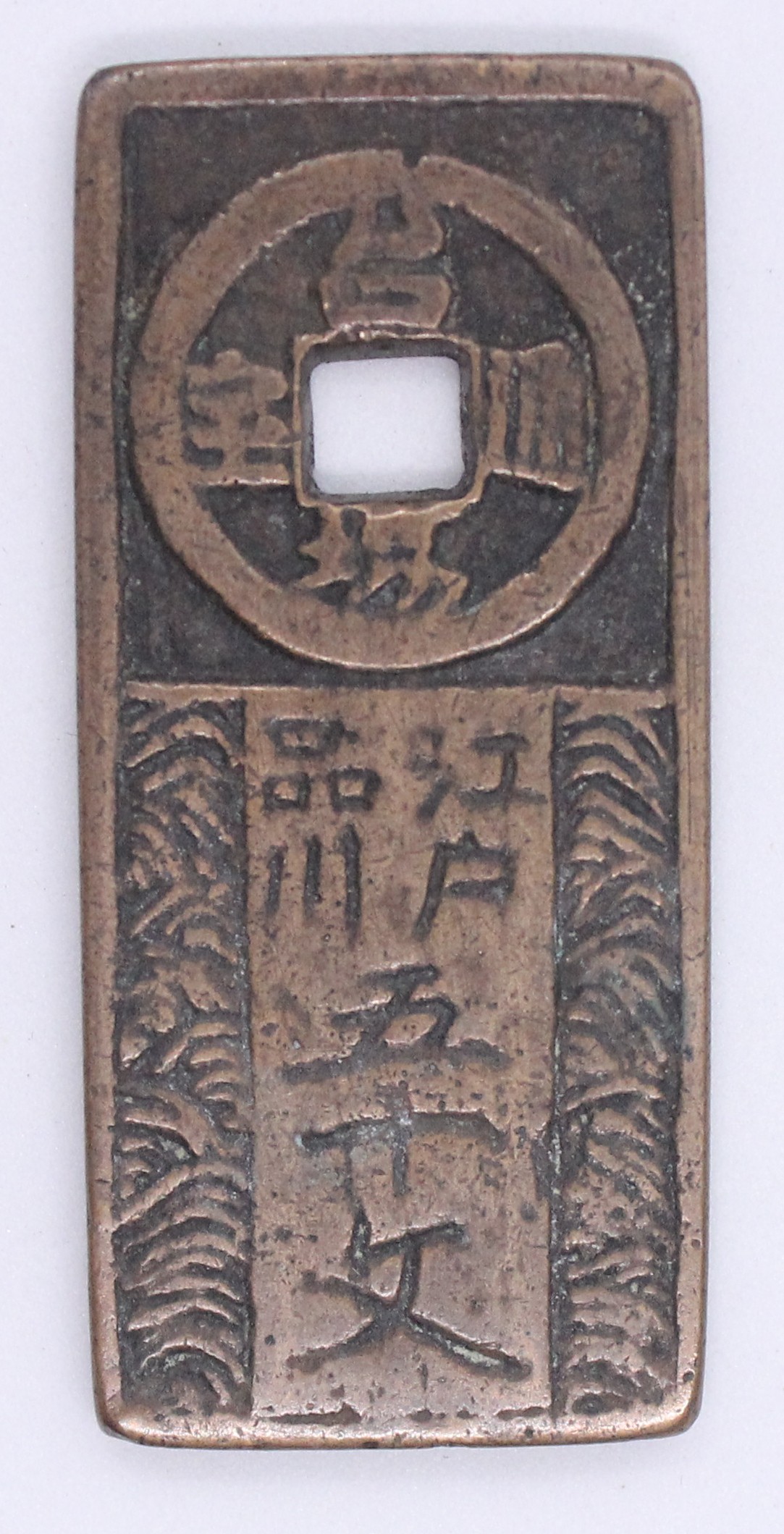
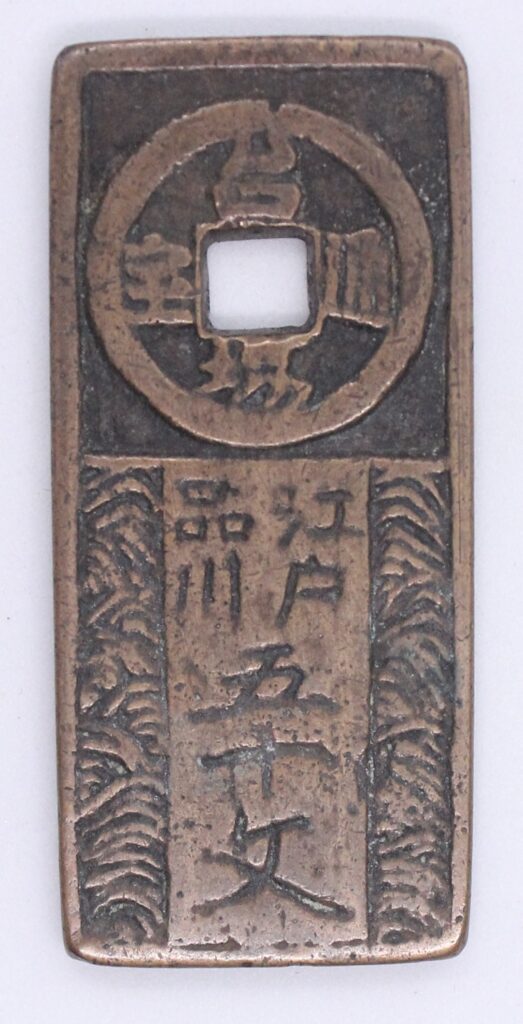
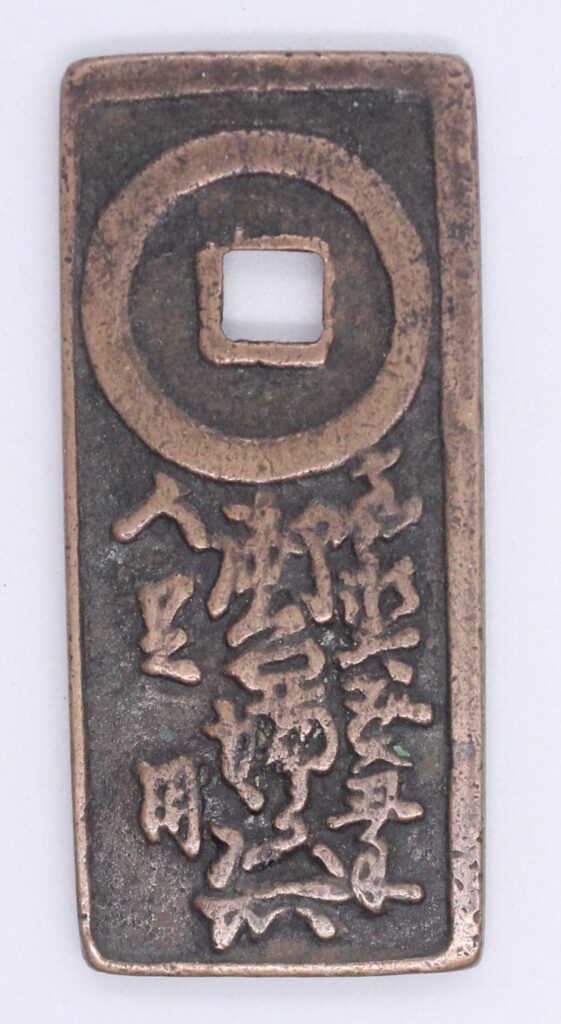
| Obverse | Reverse |
| 台場通宝 江戸品川五十文 | 嘉永六癸丑年御台場役所 人足用 |
| 台場(Daiba) 通宝(Tsuho) 江戸(Edo era) 品川(Shinagawa ) 五十文(50 Mon) | 嘉永(Kaei era) 六(6year) 癸丑年(1853 MizunotoUsi year ) 御台場(ODaiba) 役所(Yakusho) 人足用(Ninsokuyou) |
| Daiba Tsuho Edo Shinagawa 50 Mon | It says “1853, distributed as wages to those engaged in construction, Odaiba Office.” |
This is the 50-mon version of the Odaiba Tōhō coin I introduced previously. It is slightly smaller than the 250-mon coin.
⇒Daiba Tsuho 250 Mon Coin imaginary money Japanese Old Coin
Like the 250-mon coin, this piece is likely made of brass.
Mr. Odabe is said to have created regional coins and fictional coins like this one, and they occasionally appear at auctions.
For the record, the History of Shinagawa Town (published in February, Showa 7) features a photograph of a life-size coin referred to as the “Daiba Tsūhō,” and the History of Shiba Ward (published in March, Showa 13) includes a record stating, “Since paying salaries in standard currency was cumbersome, for convenience’s sake, a new 50-mon coin was minted—this was the Daiba Tsūhō.” 250 mon were newly minted for convenience—these are the Daiba Tsūhō.” While this suggests the coins may have actually existed, the truth remains a mystery unless we can travel back in time.
It is unclear whether these coins were actually in circulation, but since some long-time coin collectors claim they were likely produced by Mr. Odabe after 1914, we will treat them on this page as his creations.
These coins are, at most, 100 or 200 years old—not that ancient—but the fact that the truth remains unknown may be part of their charm. While they aren’t necessarily worth going out of your way to collect, it might be interesting to try collecting them as a set with the 250-mon coin version.
| Metal | probably brass |
| Weight | 21-24 grams |
| Diameter | 50mm×22mm |
| Denomination | 50 Mon |
| Mintage | No date |