JNDA#01-39
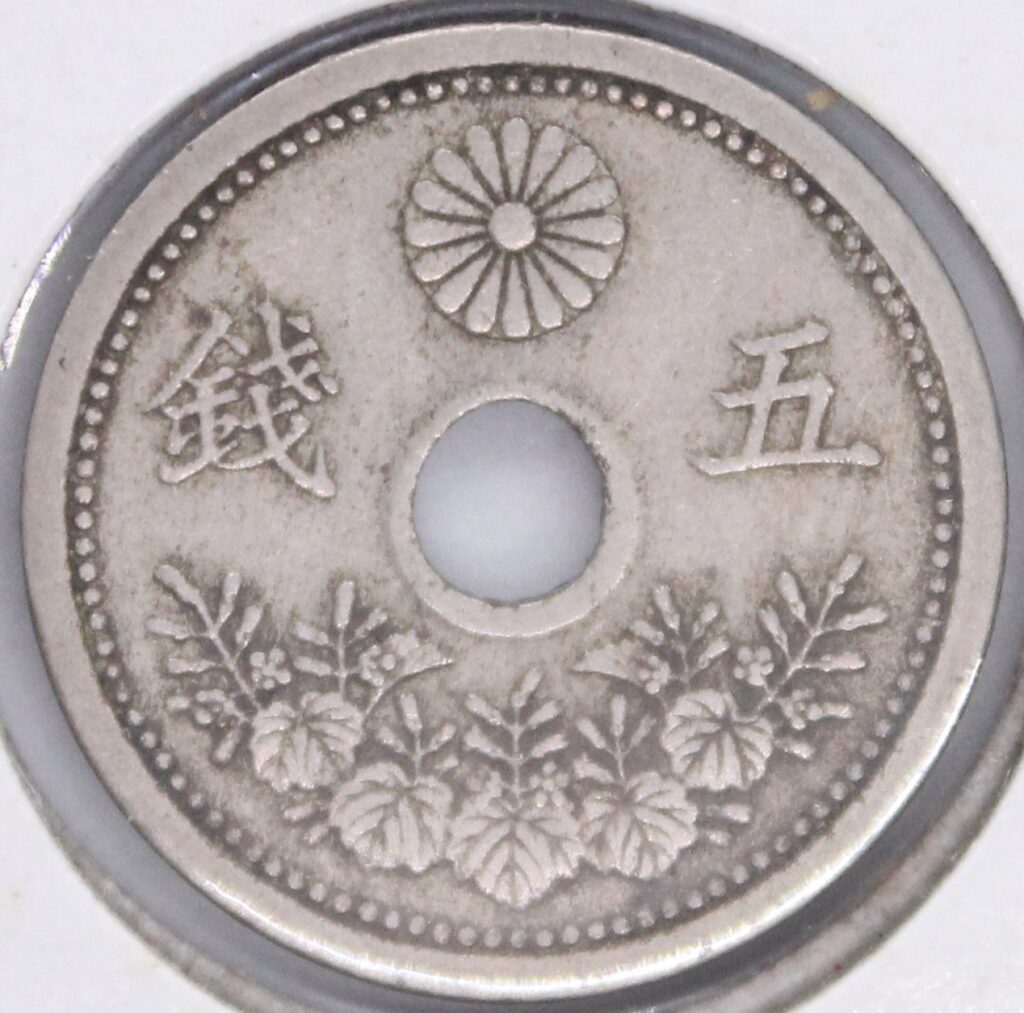
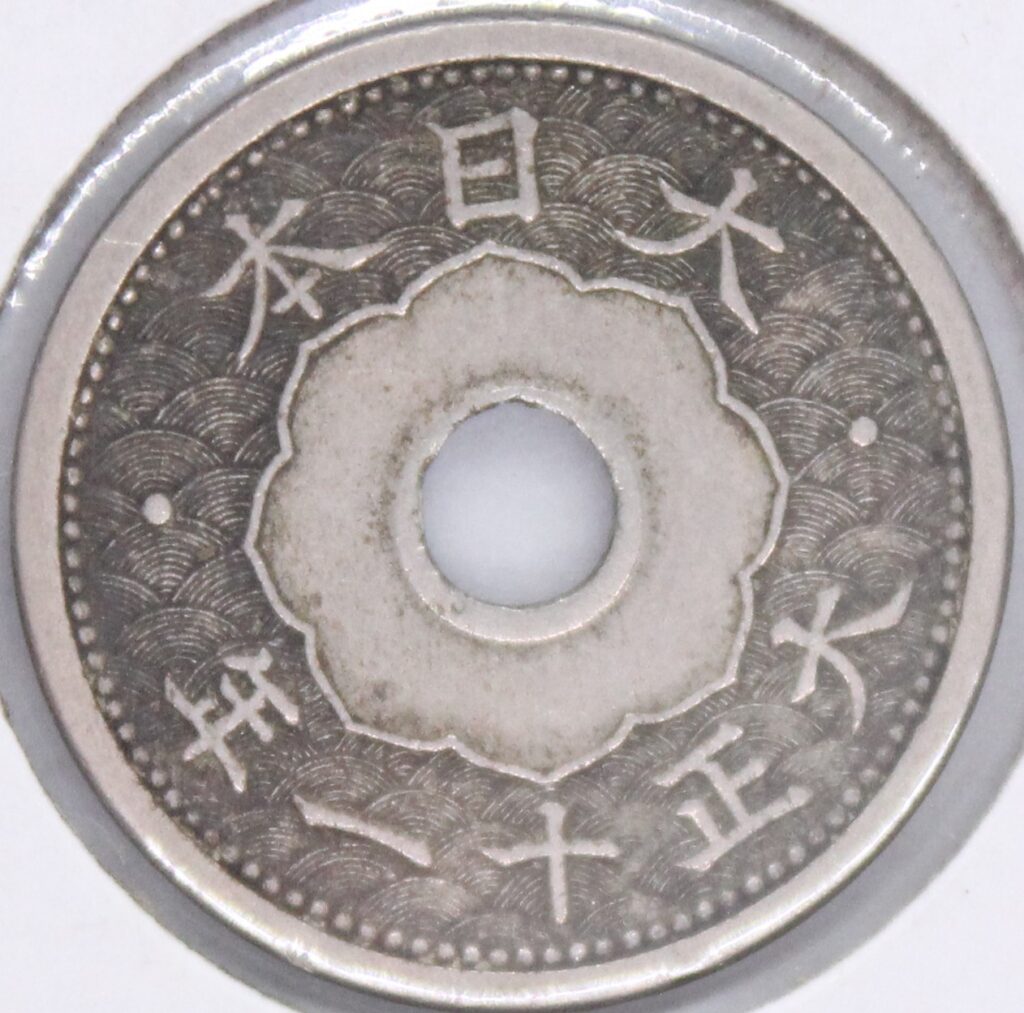
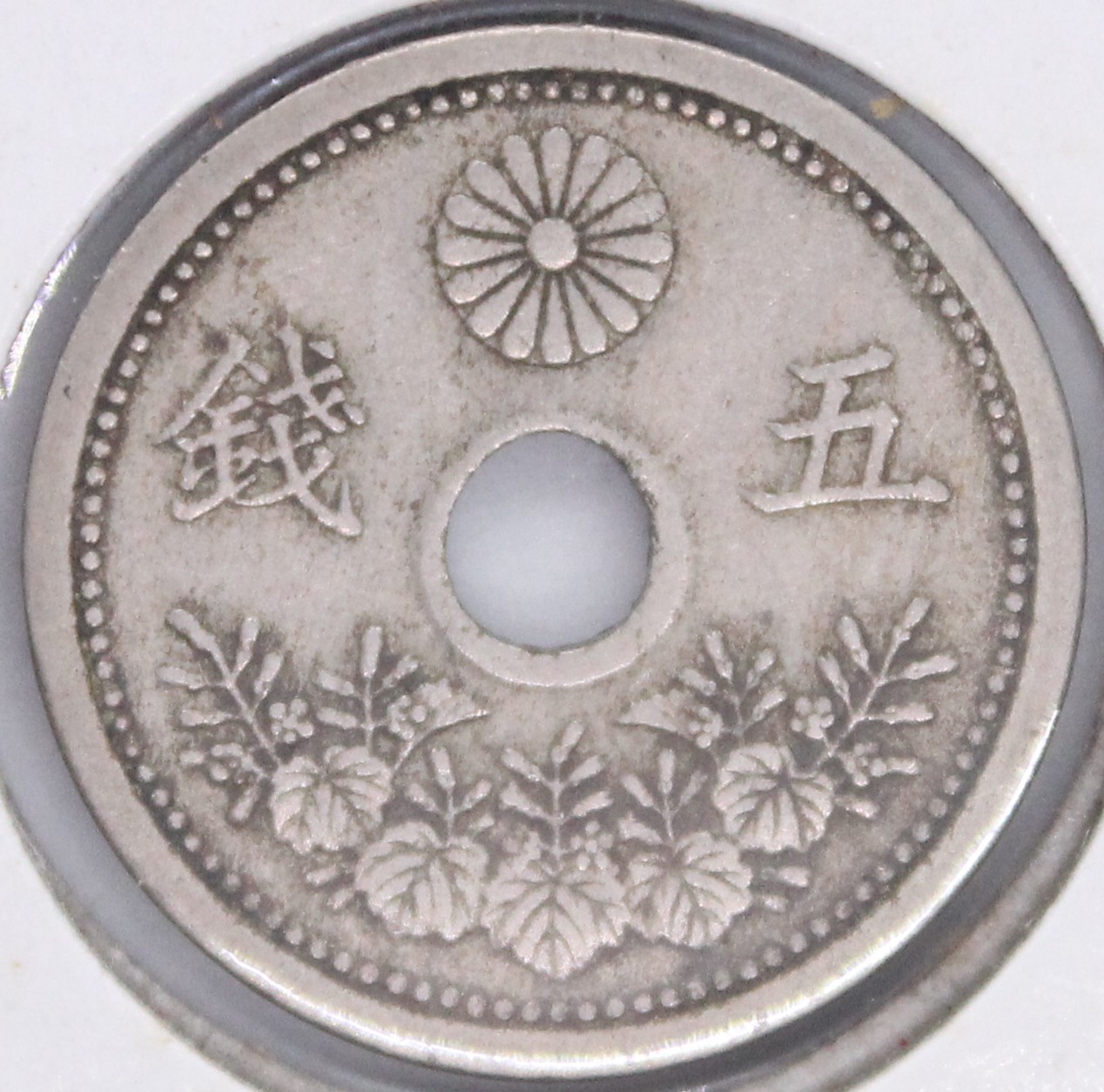
This 5-sen coin(JNDA#01-39) was issued from 1920 to 1923 and again in 1932.
Due to increased demand for silver during World War I, which led to a shortage of small change, these coins were made of copper and nickel. They were issued in large quantities over the four years starting in 1920, but production was suspended after 1924. However, the Manchurian Incident soon broke out, and due to military demand and an economic boom, small change became scarce again, leading to the resumption of issuance in 1932—the first time in eight years. While its design resembles that of the large 5-sen white copper coin (JNDA#01-38) issued between 1917 and 1920, JNDA#01-38 is slightly more valuable because most of those coins were recalled.
The small 5-sen coin (JNDA#01-39) can be obtained relatively inexpensively.
The obverse features the Imperial Chrysanthemum crest and the Paulownia , while the reverse depicts an octagonal mirror (hachiryōkyō八稜鏡) and the Seigaiha(青海波) wave pattern.
The “chrysanthemum” and “paulownia” crests are the two most prestigious emblems, symbolizing the highest authority of the Japanese Imperial Family and the state. The chrysanthemum symbolizes the Emperor himself, while the paulownia crest symbolizes the supreme ruler holding political power; historically, they have been used distinctively while maintaining a close relationship.
An octagonal mirror (hachiryōkyō八稜鏡) is a bronze mirror with an outer rim protruding in the shape of eight petals (ridges). It was introduced from the Tang Dynasty of China in the late 7th century and became widely popular in Japan as a Japanese-style mirror from the Heian period onward.
“Seigaiha(青海波)” is a traditional Japanese pattern (Wagara和柄) featuring overlapping semicircular waves arranged in a latticework design. As an auspicious motif embodying the wish for “a peaceful life to continue forever,” derived from the image of gently rolling waves stretching endlessly, it is widely used on kimonos, tableware, and in architecture.
This coin is smaller than the current 1-yen coin, measuring only 19.09 mm in diameter.
| Year | Mintage | |
| 大正九年 Taisho9year | 1920 | 100,455,537 |
| 大正十年 Taisho10year | 1921 | 133,020,000 |
| 大正十一年 Taisho11year | 1922 | 163,980,000 |
| 大正十二年 Taisho12year | 1923 | 80,000,000 |
| 昭和七年 Showa7year | 1932 | 8,000,394 |
| Material | Cupronickel |
| Composition | Copper 750 Nickel 250 |
| Weight | 2.63g |
| Diameter | 19.09mm |
The 1932 issue has the lowest mintage and is therefore considered to be of higher value.